

 PT
 English
 Português





The brake chamber size chart is a lookup that turns a chamber's type number into effective diaphragm area, then pairs it with the stroke class, pushrod length and port detail that decide whether the part actually fits. In practice, Type 24 and Type 30 chambers cover most heavy drive and trailer axles, Type 9 to Type 16 sit on steering axles and lighter trailer positions, and the clamp band of a Type 30 chamber is nowhere near 30 inches across. Match the type first, the stroke class second, and measure the chamber you are removing before you order.
Getting it wrong is not a cosmetic problem. A chamber one size off changes pushrod force by roughly 20-25% at the same air pressure, and the slack adjuster on the vehicle was set for the original geometry.
Conteúdo
- What the Type Number Means on a Brake Chamber Size Chart
- Five Numbers That Finish the Size Chart
- Standard and Long Stroke Are Different Parts
- Keep Both Ends of an Axle Identical
- Why the Chart Looks Different for S-Cam, Disc and Wedge Chambers
- Ordering Mistakes That Trigger a Second Shipment
- Frequently Asked Questions
What the Type Number Means on a Brake Chamber Size Chart
The type number is the effective diaphragm area in square inches, not the outside diameter of the can. A Type 30 chamber therefore has about 30 square inches of working diaphragm area; at 100 psi it produces roughly 3,000 lbf at the pushrod before spring and friction losses, against roughly 2,400 lbf for a Type 24.
That gap explains a very common mistake: fitting a bigger chamber "to get more brake". The extra force is real, but so is the change in brake balance and pushrod travel, and the vehicle was designed and certified around the original size. The trade-off is examined in more depth in how brake chamber size affects braking system efficiency.
| Type | Effective area | Typical configuration | Where it is usually fitted |
|---|---|---|---|
| 9 | 9 in² | Single diaphragm service | Steering axles, light trailers |
| 12 | 12 in² | Service or spring | Steering, light drive axles |
| 16 | 16 in² | Service or spring | Steering, trailer and medium-duty positions |
| 20 | 20 in² | Service or spring | Drive axles, trailers |
| 24 | 24 in² | Service or spring (24/24, 24/30) | Drive axles and trailers, the most common general-freight size |
| 30 | 30 in² | Spring brake (30/30) | Drive axles, heavy trailers |
| 36 | 36 in² | Spring brake | Vocational, heavy-haul and off-highway |
A regular-release Type 24 rear chamber is the reference point most fleets keep on the shelf for drive-axle work:
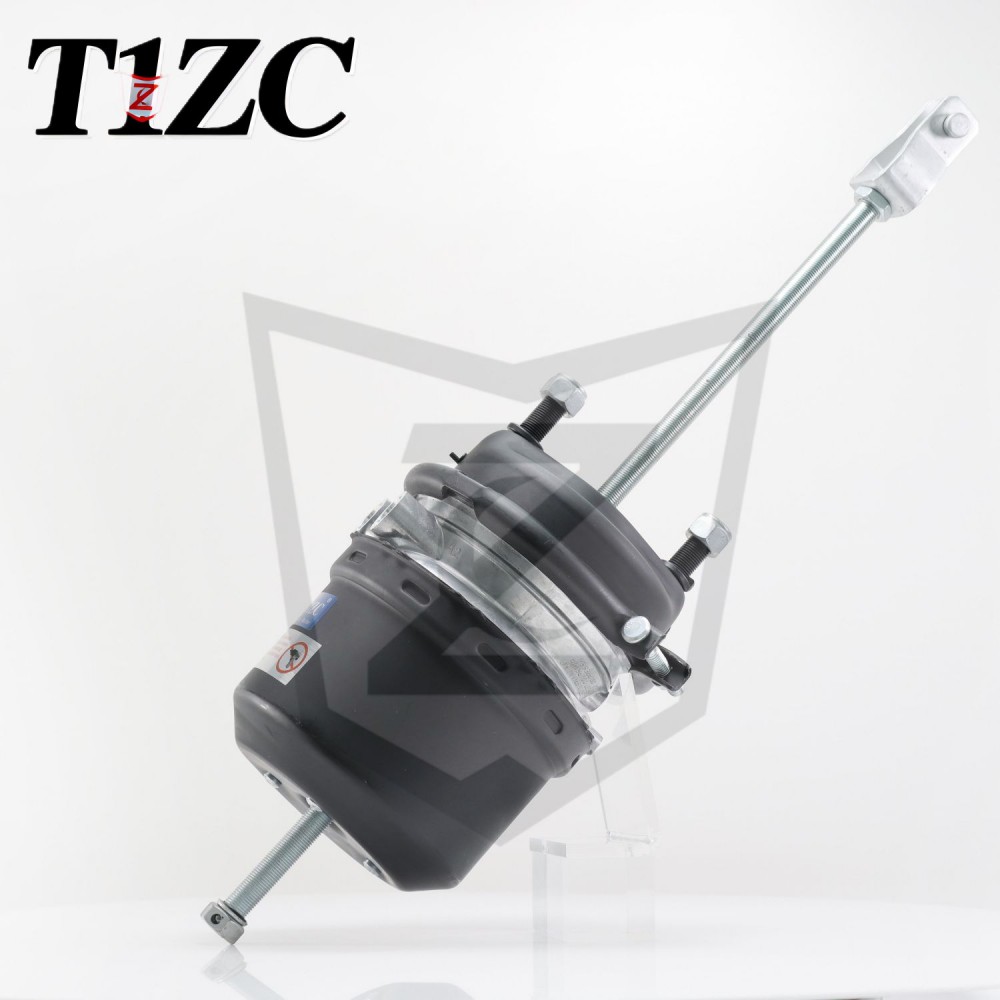 Regular Release T24 Rear ChamberThe Regular Release T24 rear brake chamber is designed for heavy-duty commercial vehicles, especially for high-load vehicles such as tractors and heavy trucks. Compare...View Product →
Five Numbers That Finish the Size Chart
The type number is only the first of five dimensions you need to match before a chamber both fits and works. Stroke class, pushrod length, inlet port, mounting pattern and service-versus-spring construction each eliminate parts that a type-only search will happily offer you.
| What to check | How to confirm it | Why it decides fit |
|---|---|---|
| Type stamp | Read the nameplate or the stamp on the body; if it is unreadable, measure the clamp band | Sets the reference for every other check |
| Clamp band outside diameter | Caliper across the band, or a tape around it and divide by 3.14 | Quick cross-check when the label is gone |
| Stroke class | Stamped suffix or datasheet wording: standard or long stroke | Changes the part number and the pushrod travel limit |
| Pushrod length | From the chamber face to the centre of the clevis pin hole | Linkage geometry; a substitute length cannot simply be cut and welded |
| Inlet port | Thread gauge on the supply port | Thread type varies by market and model; a wrong fitting means leaks |
| Mounting pattern | Bolt hole spacing and bracket angle, plus clearance to the axle | The body can foul the axle or the air line |
| Service or spring | Body shape; a spring brake has a parking section and a release bolt | Determines the safe removal procedure |
Measure pushrod length to the centre of the pin hole within about 2 mm. Anything looser and the clevis runs out of thread engagement or the shoe rides the drum.
Standard and Long Stroke Are Different Parts
Two chambers with the same type number but different stroke classes are not interchangeable. A long-stroke chamber carries more usable pushrod travel to work with automatic slack adjusters; fitting a standard-stroke unit where a long-stroke one was specified eats the reserve travel, and the adjuster runs out of margin long before the lining is worn out.
The reverse swap is just as risky: extra travel on a vehicle set up for a standard chamber can push the pushrod far enough that the chamber bottoms out and the brakes release slowly or drag.
| Type | Standard stroke limit | Long stroke limit |
|---|---|---|
| 9 | 1-3/8 in | 1-3/4 in |
| 12 | 1-3/8 in | 1-3/4 in |
| 16 | 1-3/4 in | 2 in |
| 20 | 1-3/4 in | 2 in |
| 24 | 1-3/4 in | 2 in |
| 30 | 2 in | 2-1/2 in |
| 36 | 2 in | 2-1/2 in |
Those figures are inspection limits, not adjustment targets. A chamber reading close to the limit usually means worn linings, a lazy slack adjuster or a tired diaphragm, so fix the cause rather than just bolting on a new can. Long-stroke single S-cam chambers in the 36 series follow the same rule:
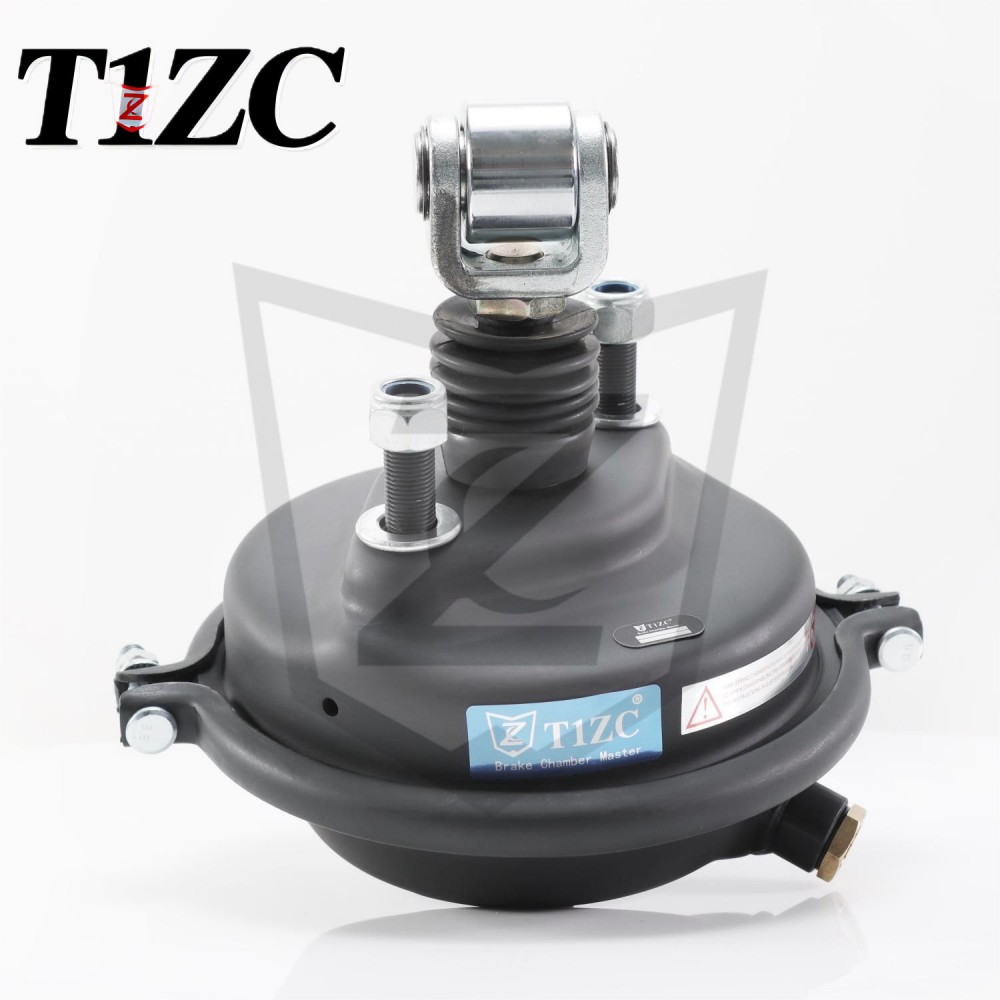 36GLL Single S-cam Brake ChamberThe 36GLL single S-CAM brake chamber is designed for medium to heavy commercial vehicles. It combines advanced S-CAM technology with high-strength materials to provide...View Product →
Keep Both Ends of an Axle Identical
Service and spring chambers on opposite ends of the same axle must be the same size and stroke class. US federal rules (49 CFR 393.47) require it, and the physics agrees: two different diaphragm areas on one axle apply different force to each wheel end, which shows up as pull under braking, uneven lining wear and confused ABS or ESC behaviour.
- Replace both sides together when one chamber has failed; a matching pair costs less than a second roadside repair.
- Match the stroke class as well as the type, even when the clamp bands look identical.
- After fitting, re-check pushrod travel at 90-100 psi on both sides before the vehicle goes back into service.
- Note the type and stroke class in the maintenance file so the next order does not depend on a faded label.
Why the Chart Looks Different for S-Cam, Disc and Wedge Chambers
The type number means the same thing across families, but the mounting face, release mechanism and pushrod geometry do not. A Type 24 S-cam chamber and a Type 24 disc chamber share a diaphragm area and almost nothing else.
S-cam piggyback chambers remain the volume part on drum-braked trucks and trailers, because the camshaft and the chamber work as one package. Disc chambers, whether single, double diaphragm or double piston, use a shorter body, different clocking and often a different release method for the parking spring. Wedge chambers survive on older and certain European axles, where the actuator pushes a wedge between two shoes instead of rotating a cam.
When you are working from a type number and a photo, compare body shapes across the S-cam brake chamber range before you commit to an order.
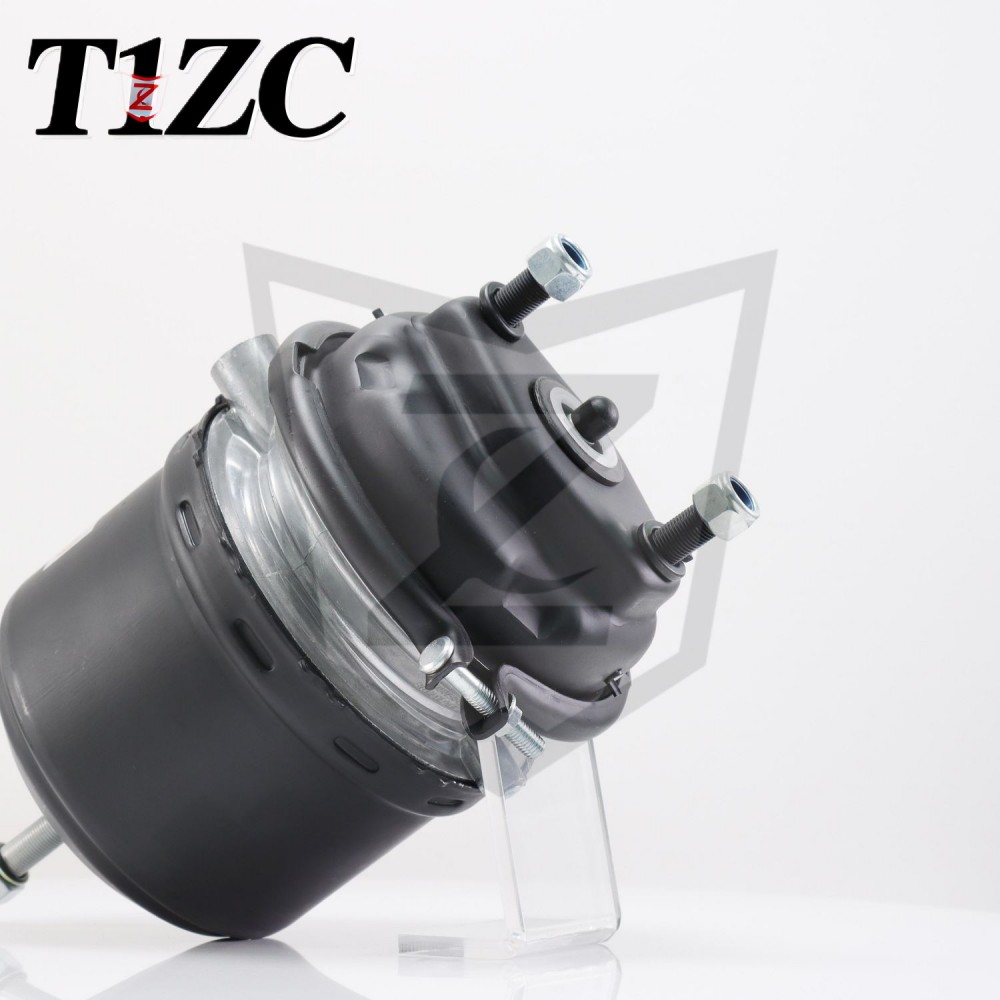 Regular Release T30 DP Disc Brake Rear ChamberRegular Release T30 DP Disc Brake Rear Chamber is a rear brake chamber designed for high performance and high reliability. Technical Features T30 DP Design: This brake...View Product →
Ordering Mistakes That Trigger a Second Shipment
Nearly every wrong-chamber order traces back to one of five shortcuts.
- Buying on the type number alone, without the stroke class and pushrod length.
- Treating a long-stroke chamber as an upgrade, when it is a different specification.
- Reusing the old clevis and trimming or packing the pushrod to make it reach.
- Ignoring port orientation, so the air line fouls the axle on full application.
- Skipping the slack adjuster check afterwards, then blaming the new chamber for a dragging brake.
Photograph the old chamber from three angles, write the clamp band diameter and pushrod length on the box, and the size chart stops being a guessing game.
Frequently Asked Questions
What size brake chamber does my truck have?
Read the stamp on the body first. If it is gone, measure the clamp band and the pushrod, then compare both against the chart. Drive axles on general-freight tractors usually carry Type 24 or Type 30 chambers, while steering axles commonly use Type 12 to Type 20.
Is a bigger brake chamber always better?
No. A larger effective area produces more pushrod force at the same pressure, but it also changes balance, travel and the load on the slack adjuster. The vehicle was designed around a specific size, and going up one type can leave the brake either over-adjusted or slow to release.
Can I fit a long-stroke chamber in place of a standard one?
Only if the pushrod travel limit, slack adjuster and vehicle specification allow it. The two versions share a mounting pattern, not a stroke, so mixing them on one axle or one vehicle creates an inspection problem and uneven brake timing.
How do I identify a chamber with no readable label?
Measure the clamp band outside diameter, the pushrod length and the inlet port thread, then match the combination to a manufacturer datasheet. Body shape, release type and port clocking narrow it down quickly, and suppliers can usually confirm from clear photographs.
Do front and rear chambers have to be the same size?
No. Sizes differ between axles by design. The rule applies within a single axle: both ends must use the same size and stroke class so each wheel does the same share of the braking work.
A brake chamber size chart is only a starting point, but it saves a surprising number of returns. Confirm the type, confirm the stroke, measure the pushrod, and check the port before the order goes out. Three minutes with a caliper beats a week of waiting for a replacement shipment.
